Image Not Found

Art collective that treats public space as a playground, a stage, and occasionally a bug in the system.

Friday, 11 September · 10:00am – 12:00pm – (add to calendar) Great Hall of the National Gallery Prague’s Trade Fair Palace. freely accessible

Public space belongs to everyone.

At least that is what we are told.

So why does it so often feel designed for obedience?

Walk here.

Wait there.

Do not touch.

Do not gather.

Do not interrupt the smooth surface of the city.

This workshop is an invitation to interrupt it.

Join Image Not Found collective at The Tent, part of the 2026 Biennale Matter of Art, to explore how paint, stickers, theatre, data, and small acts of disruption can make people notice, question, and react.

We will look at public space as a playground, a stage, and a system full of bugs.

No perfect skills required.

No official permission required.

Just curiosity, imagination, and the willingness to leave a little more involved than you entered.

Come curious.

Leave involved.


Subscribe to our RSS | About Us | Discuss... |


Public space is not only made of streets.

It is also made of rooms.

Chairs facing a stage.

People sharing the same air.

A microphone waiting for someone to say the thing that may stay in another person’s head.

We painted holes to make people look down.

We made postcards to make people look up.

Now we are entering conferences.

Sending messages through ears and into brains.

Not only to inform.

To create a reaction.

ARTivism: Hacking culture to defend privacy

DARK Prague 2026

Prague, October 2 to 4, 2026.

Accepted.

Decentralization only matters when people use it.

But most people do not begin with protocols, architecture diagrams, or cryptography.

They begin with meaning.

With a story.

With a feeling that something important is being taken away.

This talk starts with art as activism.

It looks at projects such as System Err 2052, where theatre turns privacy, autonomy, and technological control into something an audience can experience together.

The stage becomes a testing environment.

The audience becomes part of the system.

Abstract ideas become choices with consequences.

From there, the talk moves into cypherpunk culture, where code, art, resistance, and imagination have always worked together.

Building privacy technology is not enough.

People must understand it.

They must trust it.

They must be able to use it without becoming experts first.

Usability is not decoration added after the serious work is finished.

Usability is part of the resistance.

A privacy tool that nobody can understand protects nobody.

A decentralized network that nobody wants to enter remains an empty room.

Developers are not only building software.

They are shaping what kinds of freedom people can actually reach.

Pleasure without permission

Big Time Sensuality: The Politics of Pleasure

Prague, November 4 and 5, 2026.

Proposal submitted.

Not yet accepted.

Mainstream platforms decide what people can publish, discover, support, and sometimes even imagine.

They decide through recommendation systems, moderation policies, payment restrictions, commercial priorities, and rules that can change overnight.

Lawful adult expression often disappears inside these systems.

Artists lose access to audiences.

Communities lose spaces they built.

People are told which desires are acceptable enough for an advertiser.

This proposal looks at decentralized erotic networks as another kind of public space.

A playground.

A gallery.

A stage.

A small bug inside a much larger system.

These networks can give artists more control over their work and their relationships with audiences.

They can make space for queer expression, fantasy, furry art, anime-inspired work, experimental media, and specific consensual interests that centralized platforms may suppress or hide.

People do not have to remain passive consumers.

They can become curators.

Supporters.

Collaborators.

They can help shape the culture around them instead of waiting for an algorithm to choose it for them.

Decentralization can also reduce dependence on companies that take large fees, block payments, demonetize adult creators, or remove accounts without warning.

Open protocols can help art travel while creators keep their identities, communities, and independence.

But freedom is not the absence of responsibility.

It requires consent.

Privacy.

Legality.

Age-appropriate access.

Accountable community governance.

Decentralization does not remove responsibility.

It asks more people to carry it.

The goal is not a network without rules.

It is a network where the rules are not controlled by a single invisible hand.

Erotic art should not have to wait quietly for institutional permission.

Neither should the communities growing around it.

Sharing is caring

TEDxSofia

Sofia, November 28, 2026.

Open data sounds technical.

It often looks like a file nobody opens.

A spreadsheet on a government portal.

A map hidden behind a difficult interface.

A public record published because somebody was required to publish it.

But data becomes powerful when someone takes it out of storage and puts it into motion.

A transport dataset can show which neighbourhoods are being left behind.

A public budget can reveal what a city values.

Environmental measurements can make invisible pollution visible.

A map can help people repair a street, protect a place, or organize a community.

Sharing is not the final step.

It is the beginning of another person’s work.

Open data allows journalists to investigate.

Artists to interpret.

Developers to build.

Researchers to connect patterns.

Citizens to ask better questions.

But publishing data is not enough.

It must be understandable.

Reusable.

Accessible.

People must be able to find it and know what they are allowed to do with it.

The talk is about moving from access to action.

From downloading a file to changing something outside the screen.

Open data cannot change the world by itself.

People change the world.

Data can help them see where to begin.

One last thing

A conference is a temporary public space.

It has streets made of corridors.

Walls made of people.

Doors made of questions.

For a few minutes, everyone agrees to listen.

That creates an opening.

An idea can enter through the ears.

It can reach the brain.

Sometimes it stays there.

Sometimes it leaves the building inside another person and becomes a project, a conversation, a piece of code, a protest, or a different decision.

We are not entering these rooms only to describe the world.

We are entering them to disturb it a little.

Some people will listen and do nothing.

Speak anyway.


Subscribe to our RSS | About Us | Discuss... |


In June, the cameras traveled.

Paint the Cameras Dead launched on Product Hunt and became Launch of the Day on June 26.

Paper postcards landed among apps, AI tools, and software.

Then IETM shared the campaign, inviting artists, venues, festivals, and community spaces to translate, print, and distribute it.

On June 30, CultureNet carried the campaign into Czech.

It did more than describe the postcards.

It told people to download them, adapt them, place them in public spaces, and act.

Anuj shared the project on X, and the message also travelled through LinkedIn.

Product Hunt Pickups carried it into Japanese.

HuntScreens, Mindber, StartupTile, and UIComet collected it into their directories.

A physical campaign about surveillance entered systems built to watch, sort, and circulate links.

The internet has a sense of humour.

A postcard is a link made of paper.

You hold it.

You pass it on.

You leave it for someone else to find.

Sometimes they look up.


Subscribe to our RSS | About Us | Discuss... |


TL;DR: Paint the Cameras Dead (read more) asks people to notice the surveillance infrastructure disappearing into the background of our cities. Look up. Find the cameras. Ask who placed them there and what they see. Map them, but do not stop there. Respond with something of your own. A drawing. A sticker. A message. An intervention we have not imagined yet.

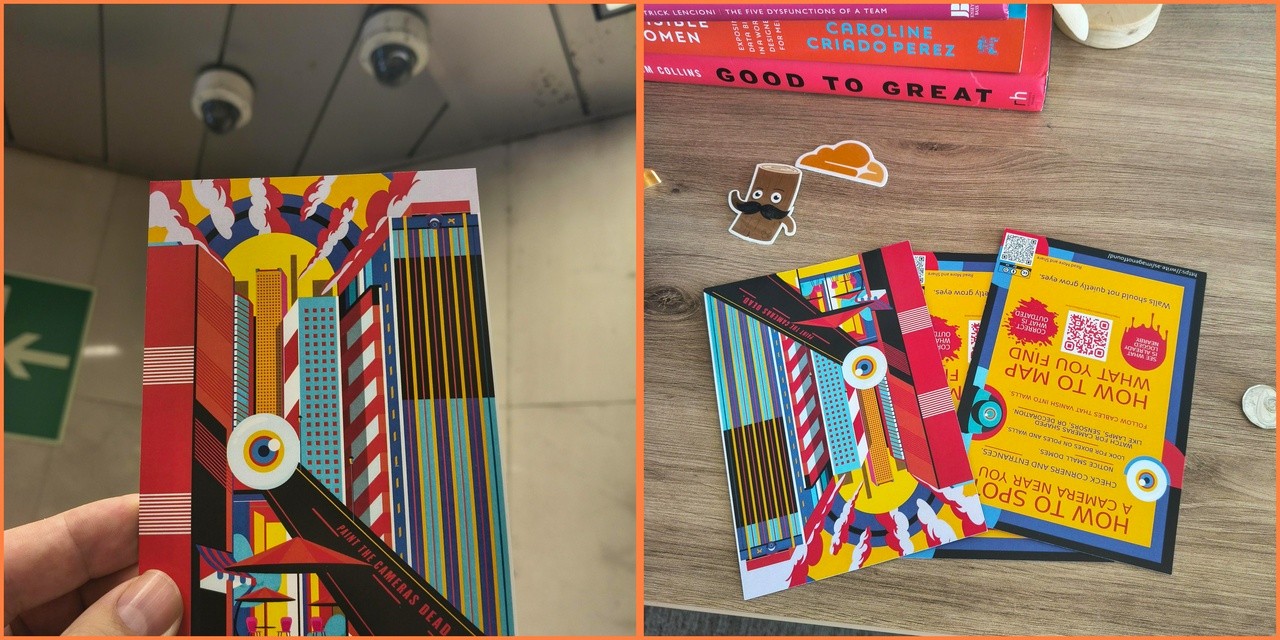
The postcards are now available.

The postcards are now available.

Looking is only the beginning

A camera watches.

You can watch it back.

But two objects staring at each other will not change much.

The point of noticing a camera is not to stand beneath it forever, looking suspiciously upwards.

The point is to break the spell that makes it invisible.

Once you see it, you can ask questions.

Who installed it?

What is it recording?

Where does the recording go?

Why does this wall have eyes?

You can map the camera. Correct an existing entry. Help someone else notice it.

And then you can do something more creative.

Make a drawing.

Write a message.

Design a sticker.

Create a new postcard.

Turn the camera into a character, a question, a joke or a public conversation.

The tool is not important.

The interruption is.

The postcards are ready

The postcards show people where to look and how to recognize the cameras hiding above doors, on poles and inside dark plastic bubbles.

You can read more about the campaign, download the print-ready files, or contact us to get some printed cards.

But we prefer that you print your own.

Not because we do not want to send them.

Because the campaign becomes more interesting when it stops belonging to us.

Print five.

Print fifty.

Translate them.

Change the images.

Rewrite the instructions.

Make a version for your own street, neighborhood or city.

Leave them in cafés, libraries, universities, community spaces and unexpected places where people might pause for a moment.

Do more than watch

Surveillance likes passive people.

People who walk underneath it.

People who never notice.

People who notice but decide there is nothing to be done.

The postcards are not the final action.

They are an invitation.

Look up.

Map what you find.

Then answer it with something the camera cannot produce by itself:

An idea.

Some imagination.

A small act of creative disobedience.

Some people will say nothing will change.

Make something anyway.


Subscribe to get notified for more action ideas. No spam!


Subscribe to our RSS | About Us | Discuss... |


Things move in strange ways.

Sometimes an idea starts as a pothole.

Sometimes it becomes a link.

Sometimes someone puts that link on a website where people argue, upvote, comment, ignore, save, repost, translate, or send it to one more person.

That is enough.

HackerNoon turned it into software

HackerNoon published “We Treated Potholes Like Software Bugs and Accidentally Built a Civic Hacking Playbook” on May 20, 2026.

They framed the pothole action as engineering, debugging, civic hacking, and a repeatable playbook.

That is funny.

Because we did not start with a playbook.

We started with holes.

Then we painted them.

Then someone called it a system.

Maybe that is how systems begin.

Urbanism Now put it next to cities

Urbanism Now, issue #69, included the pothole action on May 17, 2026, under “Pothole ARTivism, Mapping Biometric Surveillance, and Colorado Codifies Bike Safety.”

They described citizens using spray paint to highlight neglected potholes, prompting repairs and inspiring similar artivism in Sofia, Bulgaria.

That felt right.

Not because it was big.

Because it was placed where it belongs.

Next to bikes.

Next to surveillance.

Next to streets.

Next to the question: what can people do where they live?

Hacker News noticed the holes

Hacker News picked up the pothole story under the title “Cursing the government does not fix potholes. Spray-painting them does.”

People voted.

People commented.

People probably argued.

Good.

A pothole is also a user interface.

The city gives you an error.

You report it.

Nothing happens.

So you highlight the bug in production.

HN Buzzing carried it further

A Chinese Hacker News mirror, HN Buzzing, also listed the pothole story.

It showed the link after it crossed the 100-point mark.

That is a small thing.

But small things matter.

A painted pothole in Sofia ends up on a Chinese HN mirror.

Not because anyone planned that.

Because someone linked it.

Because someone else clicked.

Because the internet still has little side streets where things can travel without permission.

Reddit put it in the pothole pile

On Reddit, the story appeared in link-sharing threads.

No big introduction.

No manifesto.

Just the headline, the link, and the hole.

That is probably enough.

Reddit dropped it into a broken-car conversation

The better Reddit moment was not a post about us.

It was a conversation about potholes damaging cars.

Someone was talking about popped tires.

Someone else brought the article in.

That felt right.

Not in a marketing thread.

Not in an art thread.

In a broken-car conversation.

The hole was already there.

The link just pointed at it.

LinkedIn did the professional thing

On LinkedIn, Rozario Chivers shared “The holes we painted (and why we did it anyway).”

One post.

One link.

One professional network suddenly looking at a painted pothole and maybe thinking:

this is also work.

Not a campaign.

Not a grant proposal.

Not a strategy deck.

Work.

Remark.as opened the side doors

Remark.as created discussion pages for Image Not Found posts like “The stickers we made for the smartphone zombies” and “Paint the cameras dead.”

No big noise.

No fireworks.

Just open doors.

A page with no comments is still a place where comments can happen.

The fediverse carried the scraps

Mastodon and the fediverse picked up the links too.

There was the Hacker News bot, carrying the pothole story into another stream.

There was a toot from etc on toot.wales, sending it through a smaller, stranger, more human corner of the network.

And there was a post from bogo on hapyyr.com, letting it move again.

Small accounts.

Small boosts.

Small tunnels through the algorithmic wall.

This is how things move when they do not have a marketing budget.

Not as a campaign.

As spores.

Even the aggregators joined

A few aggregators and mirrors surfaced the links as well.

They are not love letters.

They are pipes.

But pipes matter.

Water moves through pipes.

So do ideas.

One last thing

A link is not just a link.

It is a small witness.

Someone saw the thing and decided it should be seen by someone else.

That is how a painted pothole becomes a conversation.

That is how a sticker leaves a table and enters a city.

That is how a camera stops being invisible.

Some people will say nothing will change.

Share it anyway.


Subscribe to our RSS | About Us | Discuss... |


A camera is a strange object. It hangs on a wall pretending to be invisible. It sits on a pole pretending to be part of the architecture. Sometimes it is black, sometimes white, sometimes hidden in a smoked plastic bubble so you cannot even see where it is looking.

And after a while you stop seeing them. Maybe that is the whole point?

One of the cards of the campaign

You walk to work under them. You buy bread under them. You enter buildings under them. You wait for friends under them. They become part of the weather.

Clouds, traffic lights, cameras.

Looking up again

People have already started mapping cameras.

The information exists.

People have already walked around cities noticing what most others ignore. They looked up, documented things, added locations, corrected information and made invisible infrastructure a little less invisible.

We liked that idea.

Not because every camera is evil. Not because every camera is secretly controlled by some underground supervillain sitting in a volcano.

Mostly because people should know what surrounds them.

And because most people still walk underneath cameras without ever noticing them.

That is where we come in.

We want to help people see them.

To know where to look.

To recognize the small black domes, the boxes on corners, the cameras pretending to be lamps, sensors or decoration.

Because once you notice something, you start asking questions.

Who installed it?

What is it recording?

Is it public?

Private?

Temporary?

Permanent?

Is it watching a doorway or swallowing an entire street?

Questions are useful things.

Surveillance prefers people who never ask them.

The postcards

So we started working on postcards.

On the front: real-world examples. Cameras above doors, cameras hiding in corners, cameras attached to poles, cameras pretending to be decoration.

On the back: instructions.

Simple things.

Look up.

Look at building corners.

Notice small black domes.

Check entrances.

Look for cables that suddenly disappear into walls.

And then if you find one, map it. Add it. Correct information. Leave the place a bit more visible than you found it.

Not visible to cameras.

Visible to people.

Paint the cameras dead

Our campaign says: Paint the Cameras Dead.

Not because paint is always paint.

Not because dead always means dead.

Because things only become untouchable when people stop seeing them.

Because surveillance works best when it becomes background noise.

Because walls should not quietly grow eyes.

Our older slogan was with one small pencil you can change the world.

This time the pencil may not even be a pencil.

Maybe it is a marker.

Maybe a sticker.

Maybe a stone.

Maybe something much more creative.

The important thing is not the object.

The important thing is noticing that the wall was watching you before you started watching back.

How you can help

Small campaigns survive on small actions.

If this idea makes sense to you, here are four ways to help:

0. Map the cameras around you

Take out your phone.

Visit this url.

See what's around you.

Start looking up and map what's not there.

1. Follow our messages and spread them

Watch our Mastodon posts and repost them.

Share the noise with your own network. Algorithms like it.

Help the message travel a little further than we can push it ourselves.

2. Print the postcards and let them travel

When the files are ready, get them from us.

Print them.

Leave them in places where people pass through and pause for a moment.

Community spaces.

Cafés.

Libraries.

Universities.

Notice boards.

Unexpected places.

The goal is simple: put the idea where eyes already are.

3. Support the work

Image Not Found survives because people decide small things are worth supporting.

If you want to help us make more postcards, more interventions and more weird little projects that interrupt everyday life, you can also donate.

One last thing

Surveillance likes passive people.

Noticing things is active.

Sometimes changing the world starts with looking up instead of looking down.

Some people will say nothing will change.

Do it anyway.


Subscribe to our RSS | About Us | Discuss... |


You have seen them. We all have. The person walking towards you on the sidewalk, looking straight down at their phone, not noticing that they are about to walk into you, a tree, a moving tram, or a hole that we have not got around to spray-painting yet.

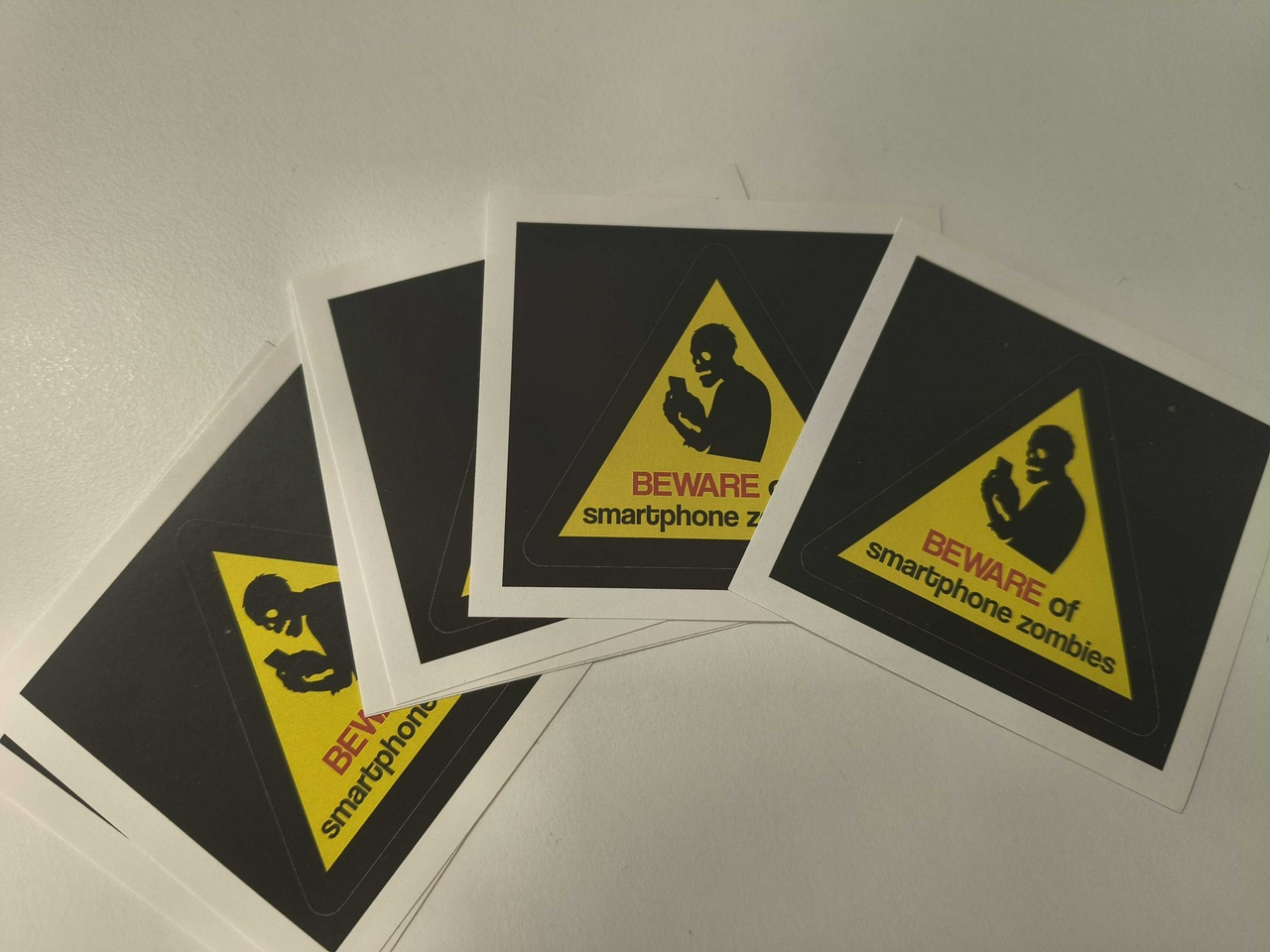
The stickers we made for the smartphone zombies

The person on the metro escalator standing still in the middle of the steps, blocking everyone behind them, eyes glued to a screen.

The kid in the café, sitting across from a parent, both of them on phones, not speaking.

The driver at the red light, who is still scrolling when the light turns green.

We call them smartphone zombies. We are not the first to use that word and we will not be the last. The problem is real, it is everywhere, and most people who see it either shrug, or do the same thing themselves five minutes later.

So we made some stickers.

What is wrong with the zombie

A lot of small things, and a few big ones.

Safety. People walking into traffic. People not hearing the bicycle bell behind them. Parents pushing strollers across the street while reading messages. Kids stepping off a curb without looking up. The first thing that goes when you stare into a screen is your peripheral vision. The second is your hearing, in a way, because your attention is somewhere else and your brain stops processing what your ears pick up. The result is small accidents at best, serious ones at worst.

Attention. The brain is not built to be interrupted every thirty seconds for a notification. People who live like this for years slowly lose the ability to read a book, watch a film without checking their phone twice, or sit through dinner without reaching for a device. This is not opinion. This is what the people who study attention will tell you for free at any conference.

Schools. Walk past a school during a break. Count the kids in groups talking, then count the kids each on their own screen.

Mental health. Doomscrolling is a hobby now. Comparison, anxiety, sleep that does not happen because the phone is on the pillow. People know this. People still do it. We know it because we still do it too, sometimes.

Loneliness in a crowd. Two hundred people in a metro carriage and not one of them is looking at another human being. Imagine explaining this to a person from 1995. They would not believe you.

None of this is news. The news is that we keep behaving as if it is unavoidable.

What we did

We printed some stickers. Simple stickers. The kind that fits on a laptop, a notebook, a lamp post, a bathroom mirror, the edge of a table at a café.

The message is short. The design is not subtle. You can see it on the image above, or, with a bit of luck, somewhere in the wild.

Then we did something on purpose. We did not put them behind a paywall. We did not run a marketing campaign for them. We took them to free and open-source software events, the kind of places where people already think a little bit differently about technology, and we gave them away. For free. To anyone who wanted to take a few home and stick them somewhere.

Where they are now

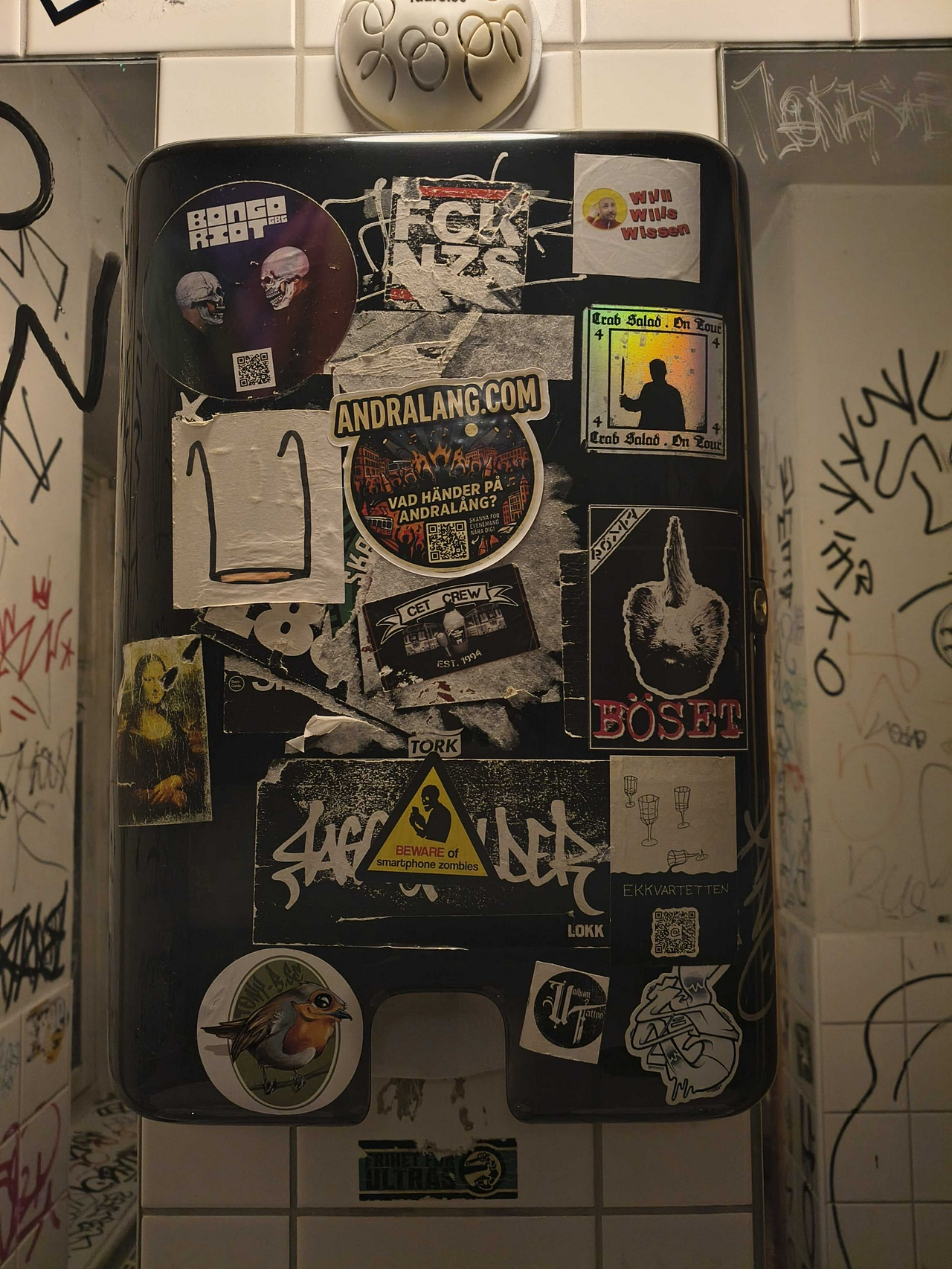
Last we heard, our stickers have made it to:

  • Bulgaria. Where it started.
  • Czechia. Where I am now, and where the campaign jumped first.
  • Belgium. Spotted around the usual Brussels conference suspects.
  • Sweden. Stickers travel well in luggage.

And the list is growing. Every time we hand out a small pile at an event, three or four of them end up in cities we have never been to. People send us photos. We smile. We print more.

Our stickers in the wild

Join the fight

If you want to help, it is easy.

  • You want a few stickers? Tell us where to send them.
  • You want the print files so you can run your own batch on your own printer, in your own city? We will send them.
  • You want to design your own version, in your own language? Even better. Send us a photo when it is done.

Get in touch

We will not ask you to sign up for anything. We will not put you on a list. We will just send you stickers, or a SVG, and trust you to do the right thing with them.

A word about ARTivism

If you read our story about painting the potholes, you already know what we are about. We are a small collective called Image Not Found, and what we do is part of a wider movement called ARTivism. The idea has not changed: art is a tool, not only decoration. A pencil. A brush. A spray can. A sticker.

This time, the tool is a sticker.

Our slogan, in this campaign, is the same idea in a slightly different shape:

With one small sticker you can change the world.

And we mean it. A sticker on a laptop is a tiny billboard. A sticker on a lamp post is a tiny billboard that thousands of commuters walk past every week. Multiply that by people in four countries and counting, and you start to see why we keep printing them.

For more examples of art-driven change, take a look at our exhibition SystemErr0.

One last thing

Nobody is going to fix this for us. Not the phone companies (they would prefer you stay glued). Not the apps (same). Not the schools alone, not the parents alone, not the government. It is going to be us, one small reminder at a time, on a laptop or a lamp post in a city we have never been to.

You can do this too. Print a sticker. Give it to a friend. Put one somewhere a zombie will see it and, for two seconds, look up.

Some people will say nothing will change.

Do it anyway.

Subscribe to get notified for more action ideas. No spam!


Subscribe to our RSS | About Us | Discuss... |


The spray-painted potholes from our original campaign

A bit more than a year ago, we did something a bit weird.

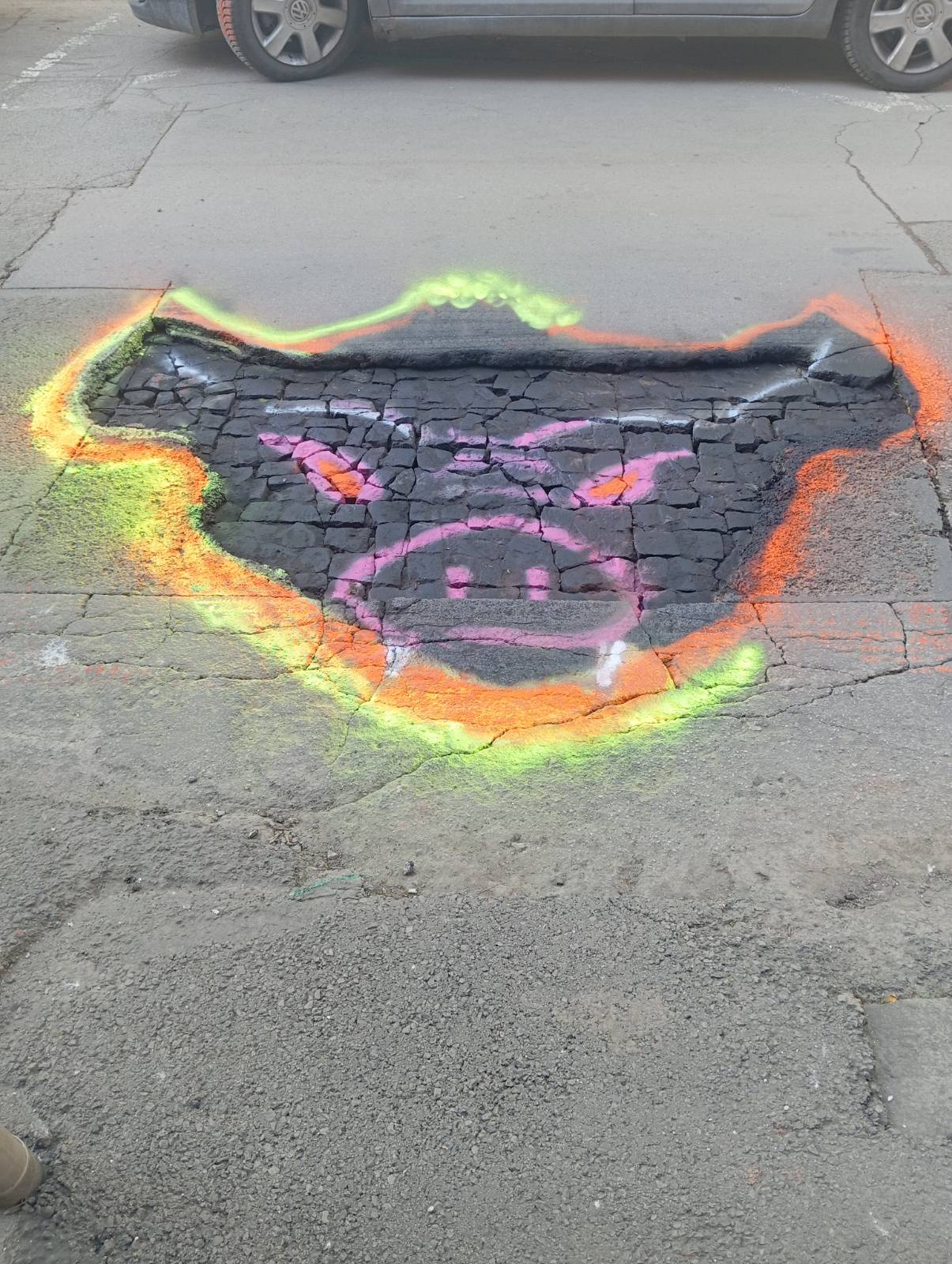
We took a few cans of spray paint and we went out on the street. Not to paint a mural. Not to make art for art's sake. We went out to paint the potholes on a road that the municipality had been ignoring for months. Maybe years. Who can count anymore.

Yes, you read that right. We painted the holes.

Why would anyone do that?

Two reasons.

The small reason: we wanted the holes fixed. People were destroying their cars on that road every single day. We called the municipality. Nothing. We sent emails. Nothing. The usual complaints in the usual Facebook groups went exactly nowhere. So we tried a different language. The language of paint and visibility. If they will not see the hole, we will make sure they cannot not see it.

The big reason: we wanted to show people that you can actually do something. That cursing the government on the bus, cursing the mayor at dinner, and cursing destiny at the kitchen table does not fix a single hole. Action does. Even small, weird, slightly silly action.

“Nothing will change”

That is what some people told us before we started.

“You are wasting your time.” “Nobody cares.” “This is how it is here, my friend, nothing will ever change.”

I get it. I really do. Apathy is the cheapest defense mechanism we have. If you decide in advance that nothing works, you never have to feel disappointed when something does not work. You also do not feel anything when something does work, but that is the trade-off some people pick.

We did it anyway.

What actually happened

A few things, in roughly this order:

  • People walking by stopped, took pictures, and laughed.
  • Local media picked it up.
  • The municipality (surprise) fixed the holes within a couple of weeks.
  • A few neighbours who told us “nothing will change” went quiet. A few said “OK, but this was a fluke.”

And then, Sofia

Here is the part I like most.

A few weeks ago, on a street in Sofia, Bulgaria, the same thing happened. Different city. Same idea. People went out, found a pothole that the municipality had been pretending not to see, and made it impossible to ignore. Spray, camera, and a bit of noise. Enough to turn a hole in the asphalt into a story.

This time the TV showed up. A real crew. A real segment. The hole, the bright paint around it, the smiling neighbours, all on the morning news. The municipality, again, suddenly remembered that road existed.

The Sofia street with the painted pothole

Do I know the people who did it?

Let's say I am not surprised. Let's say ideas travel. Let's say they travel through articles, through conferences, through coffees, and sometimes they travel from one painted hole on one street to another painted hole on another street, a year later. Let's say I might have a personal reason to smile at this particular news segment.

I will not say more than that.

The point is not who did it. The point is that someone did. Someone watched, took the idea, made it their own, and went out on their own street.

That is how this is supposed to work.

The campaign was not really about potholes

The potholes were the excuse. The real campaign was against something much harder to fix than a damaged road. It was against the belief that ordinary people cannot move the system.

You can. Not always. Not predictably. Not on the timeline you want. But you can.

So here is the playbook, if you want one:

  • Pick something small. Not the whole broken system. One pothole. One sign. One absurd rule.
  • Make it visible. Spray paint, photo, video, a sticker, a banner. Something the people in charge have to either fix or explain.
  • Get one friend. Just one. Two people is already a movement when most people are doing nothing.
  • Expect the “nothing will change” crowd. They will show up. Smile at them. Keep going.
  • Document it. So the next person sees that it worked, and tries something of their own.

A word about ARTivism

This pothole story is not a one-off. It is part of something bigger that we call ARTivism.

ARTivism is a collective. The idea is simple. Art is not only for galleries. A pencil, a brush, a camera, a sticker, a song, a poster, these are also tools of change, not only of decoration. We try to show people, by real examples, that you can use whatever creative skill you already have to push the world a little.

You do not have to wait for permission. You do not have to be a famous artist. You do not have to have a budget.

Our slogan is short and we mean every word of it:

With one small pencil you can change the world.

That is not a poster line. That is the whole strategy.

If you want to see more examples of art-driven change, take a look at our exhibition SystemErr0.

One last thing

A pothole on a road is a pothole on a road. But a pothole sprayed bright, photographed, shared, and laughed at, is something else. It is a small proof that the citizen and the system are not as far apart as we like to think.

You can do this. Not for every problem. Not every time. But more often than you believe right now.

Some people will say nothing will change.

Do it anyway.

Subscribe to get notified for more action ideas. No spam!


Subscribe to our RSS | About Us | Discuss... |


The premiere is coming soon in Sofia, Bulgaria, and we wanted to introduce it to you. It’s an experimental theater play that focuses on immersive and participatory experiences.

Logline

We have become creatures who eat, shit, and hate ourselves and others. Hate is the only emotion that boils within us. Our society screams a total lack of motivation, will for change, other emotions, and interest in the stimuli of our surroundings. Let’s change that through theatre!

The mad scientist Aheado Fyou, who finds himself in the present from the future, along with his personal assistant with artificial intelligence, P.I.T.K.A., tries to get us to change something now so we don’t find ourselves in a future situation with no rights and free will.

SystemErr 2052 - the theater play scene Licensed Under Creative Commons license by Pepita

By mixing light provocations, fine art, music, knowledge, and a lot of booze, all attendees experience a journey they will remember, at least until they leave the theater!

Inspiration

The play is inspired by Augusto Boal‘s methods, who guided us to the idea that theater is not only for tears and laughter but also for expressing an active citizen position.

Based on actual events of the last years – wars around the world, political turmoil, violation of rights, and above all, apathy and hatred in society!

The play focuses on active audience participation, which is rarely done in theater productions. It’s the best method for teaching the audience something valuable.

Music

We will have a special guest for the premiere: one of Bulgaria’s favorite punk singers, Krasimir Kunev—Kras, who will share his vision of how we can use music to restart the change!

Where and when.

Bulgaria

The premiere will be on 7 March from 19:30 at I Am Studio Theater, one of the few places in Sofia for independent and experimental theater.

We will add more locations here.

License

You may be surprised to learn that the play is licensed under a Creative Commons license, allowing anyone to modify and remix it for their own audience.


Subscribe to our RSS | About Us | Discuss... |


With one small pencil you can change the world.

Anyone. Anyone. Anyone can do it.

Systems look untouchable when you stand far away from them. Cities, institutions, rules, habits, routines. They appear fixed and permanent, as if someone designed them and everyone else simply follows along.

But every system is made of people and people can change things.

SystemErr0 is an exhibition about small interventions with unexpected consequences. Through examples of artivism, creative disruptions, and actions from around the world, it explores how tiny acts can create visible cracks in systems that people usually accept without question.

Because every change begins as a small error in reality.

Before you enter

This is not only an exhibition. It is an offline collection of examples, ideas and actions gathered by us around one question:

How can you change the world using your art skills?

TL;DR:

• Examples collected by us of people using creativity to create change • Examples from our own campaigns and experiments • Ideas you can take, remix and use yourself • Art used outside galleries, in streets, communities and everyday life • This is an offline experience, not something you can fully see on a webpage • Come visit where we show it, or invite us to bring the exhibition to your event, school, organization or space

one of the elements

Imagine

Imagine you are walking down a busy boulevard in the morning.

Your brain is running in automatic mode.

People. Cars. Dirty air. Notifications. Horns. Conversations. Children shouting somewhere in the distance.

Everything is familiar.

Everything is background noise.

Then, before crossing the street, you notice something strange.

parking forbidden sign modified to say Police is forbidden

Police forbidden

Someone decided reality needed editing.

Someone decided to express disagreement not with a speech, a complaint form, or a social media post, but with a small intervention in public space.

How would you react?

Laugh

Maybe it catches you off guard. Maybe it breaks the script of your normal day. Maybe you smile and carry that energy forward.

Small disruptions spread.

Get angry

“What happened to this sign? Aaaargh! Vandals!”

Good.

Anger is also a reaction.

At least now you are paying attention.

Walk away

Ignore it.

Pretend nothing happened.

Return to automatic mode.

Systems love passive observers.

Be a Changemaker

SystemErr0 wants to challenge you to react instead of retreat.

Artivism is not simply making art and it is not simply protesting. It is creating interruptions inside systems that became too comfortable, too invisible, or too accepted.

Cypherpunk values taught us that people do not need permission to build alternatives. Change does not always begin from institutions. Sometimes it begins from individuals acting because something feels wrong and refusing to stay passive.

We do not want visitors to leave saying:

“That was interesting.”

We want visitors to leave thinking:

“What can I change?”

Because change never begins with inaction.

It begins with a small mark.

A strange idea.

One unexpected action.

With one small pencil you can change the world.

Licenses

The majority of the work is licensed under the Creative Commons CC BY-NC-SA 4.0 license.

Donations

If you want to support the exhibition and help spread these ideas and inspirations further, you can support us by donating Bitcoin via:

Lightning Network

cleverlinda78@walletofsatoshi.com

On-chain wallet

bc1q2ulj39wxzawx9t88zz4me49yl62034chms6t3r

Contact us if you want to support us in any other way.

Thank you.


Subscribe to our RSS | About Us | Discuss... |


Enter your email to subscribe to updates.